Tag: Healthcare Operations

  • Patient Queue Management Software: What Clinics Need to Know

    Patient Queue Management Software: What Clinics Need to Know

    Patient queue management software decides who sees the doctor next, tells every waiting patient how long they have left, and gives your front desk one list to work from instead of three. For a busy clinic, it’s the difference between a calm waiting room and a reception desk answering “how much longer?” all morning.

    If you run a clinic, you know the pattern. Booked patients expect to go in on time. Walk in patients have been waiting since the doors opened. The doctor is running 20 minutes late, a booked patient hasn’t turned up, and your receptionist is trying to keep a diary, a token register and a WhatsApp chat in step.

    This guide explains what patient queue management software does, which features actually matter for a clinic, what it costs, and the questions to ask before you choose one.

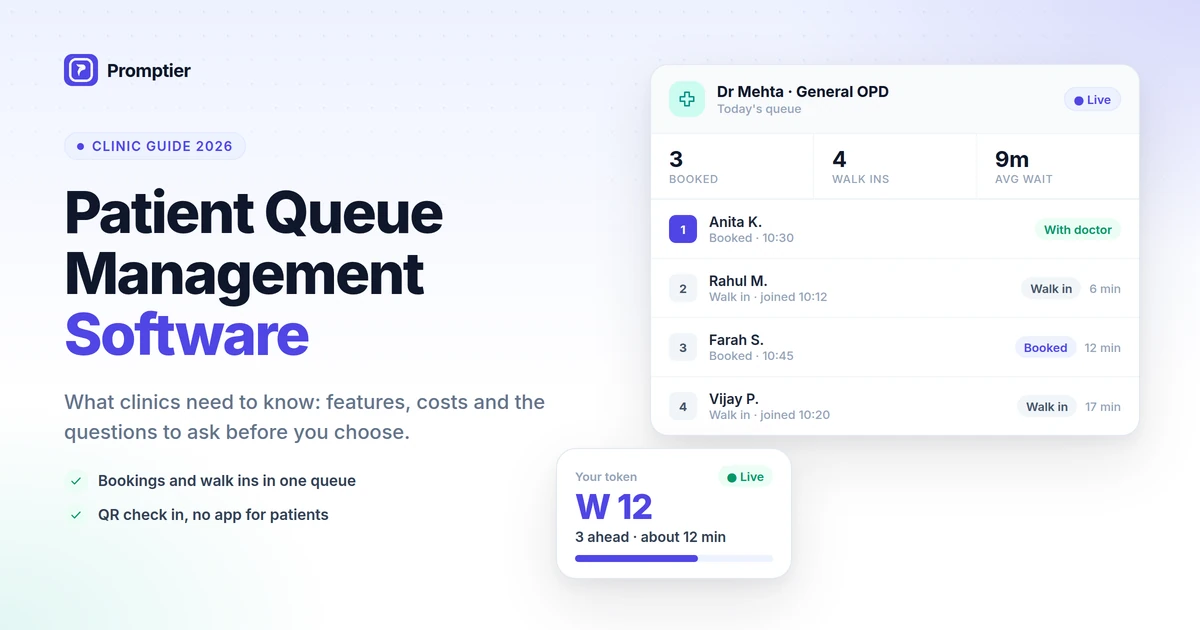
    Patient queue management software is a tool that manages the order in which patients are seen and shows each patient their live position and estimated wait. The best options for clinics put booked appointments and walk in patients in one queue, let patients check in by scanning a QR code with no app, notify them on their phone as their turn nears, and record every visit with timestamps. Browser based options run on the phones, laptops and TVs a clinic already has.

    Key Takeaways

    • The biggest source of front desk stress in most clinics is running appointments and walk ins in two separate systems.
    • Good patient queue management software puts both in one live queue, so staff call the next patient from a single list.
    • Patients should be able to check in by QR code and follow their place on their phone, with no app and no account.
    • Queue software sits next to your clinic management system or EMR. It manages the wait, not the medical record.
    • Browser based tools cost far less than token machines and can be live the same day.

    What Is Patient Queue Management Software?

    Patient queue management software is a digital system that manages how patients check in, wait and get called for consultation. It replaces paper tokens, registers and shouted names with a live queue that staff control from a dashboard and patients follow on their phones or a waiting room screen.

    Most tools do four jobs:

    1. Check in: the patient joins the queue, usually by scanning a QR code at reception or booking ahead from a link.
    2. Ordering: the software keeps one ordered list per doctor or department.
    3. Visibility: each patient sees their live position and estimated wait, and a TV shows who is being seen.
    4. Records: every entry is timestamped, so you can see real waiting times and peak hours.

    Key terms used in this guide:

    • Walk in patient: a patient who arrives without a booking.
    • Booked patient: a patient with an appointment time.
    • OPD: the outpatient department, where patients are seen without being admitted.
    • Live position: the patient’s current place in the queue, such as “3 ahead of you”, updated as patients are called.

    How it differs from clinic management software

    Clinic management software and EMRs store patient records, prescriptions and bills. Patient queue management software manages the waiting room: who is here, who is next and how long each patient will wait. Many clinics run both side by side. If your clinic management tool already has a basic token feature, the question is whether it shows patients their live position, handles walk ins and bookings together, and works without an app.

    Digital check in is already normal in India

    Indian patients are already used to scanning a QR code to register for an OPD visit. The government’s ABHA based Scan and Register service (earlier called Scan and Share) lets patients register by scanning a QR code at the hospital counter. It has crossed 25 crore OPD registrations across more than 30,800 health facilities, and the National Health Authority has said it significantly reduces waiting time at registration. Patients who can register by QR code at a government hospital will expect the same at a private clinic.

    Why Clinics Struggle With Patient Queues

    A clinic queue is harder to run than most because it mixes two kinds of patient with very different expectations.

    The appointment and walk in collision

    Most clinics take bookings in one place, such as a diary, a booking app or WhatsApp, and manage walk ins in another, such as a token machine or a register. Each works on its own. The trouble starts at the front desk, where one person has to merge two lists by hand, every few minutes, while patients watch.

    That’s where the arguments come from. “I booked for 10:30.” “I’ve been waiting since 10:05.” Both patients are right, and neither can see the other’s list.

    Other problems a clinic queue creates

    • Wait estimates are guesses. A walk in is told “about 15 minutes”, but the three bookings coming up aren’t counted.
    • No shows leave gaps. A booked patient doesn’t come, and the doctor waits while the receptionist checks the walk in register.
    • Crowded waiting rooms. Patients stay in the room for fear of missing their turn, which matters more in a clinic, where some of them are unwell.
    • Reception overload. Every “how much longer?” takes the receptionist away from new arrivals and phone calls.
    • No data. Without timestamps, you can’t tell how long patients really wait or when to add a second doctor.

    Even in large hospitals, waiting adds up. A 2024 time and motion study of an outpatient department at a tertiary hospital in Tamil Nadu measured an average total waiting time of about 32 minutes per visit. Waits like that feel far longer when patients can’t see how much is left.
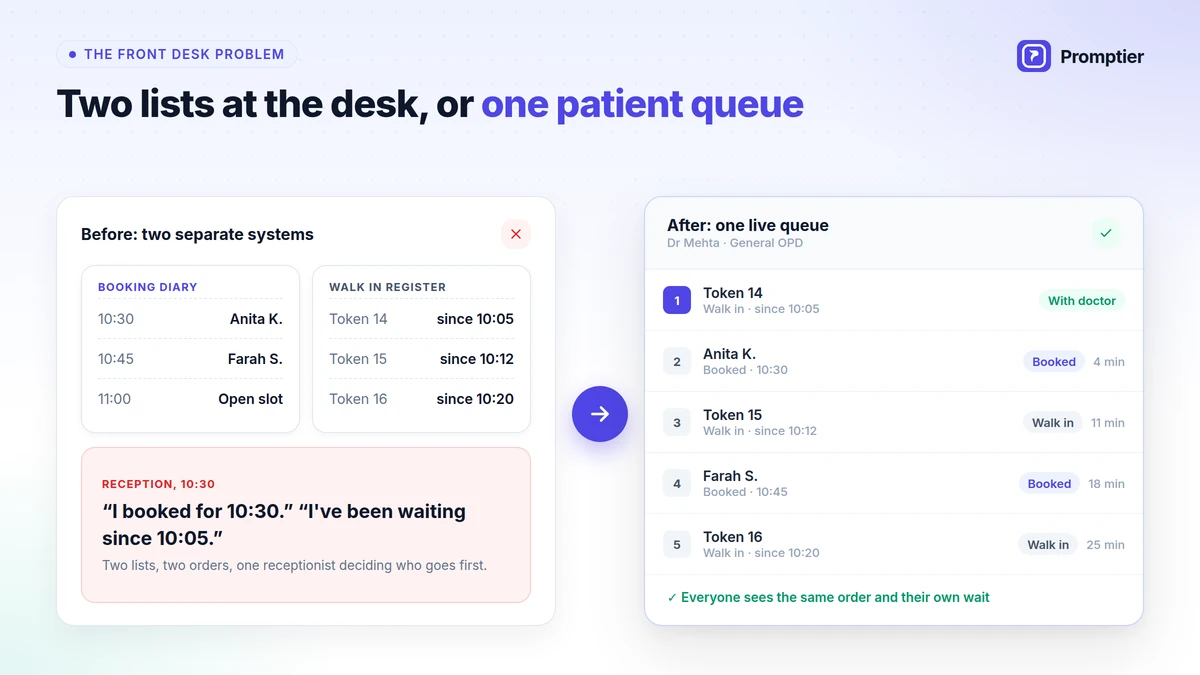
    Clinic front desk collision: a booking diary and a walk in register lead to disputes, while patient queue management software puts both in one queue

    Features a Clinic Actually Needs

    Plenty of tools call themselves patient queue management software. These are the features that make a difference in a clinic, in rough order of importance.
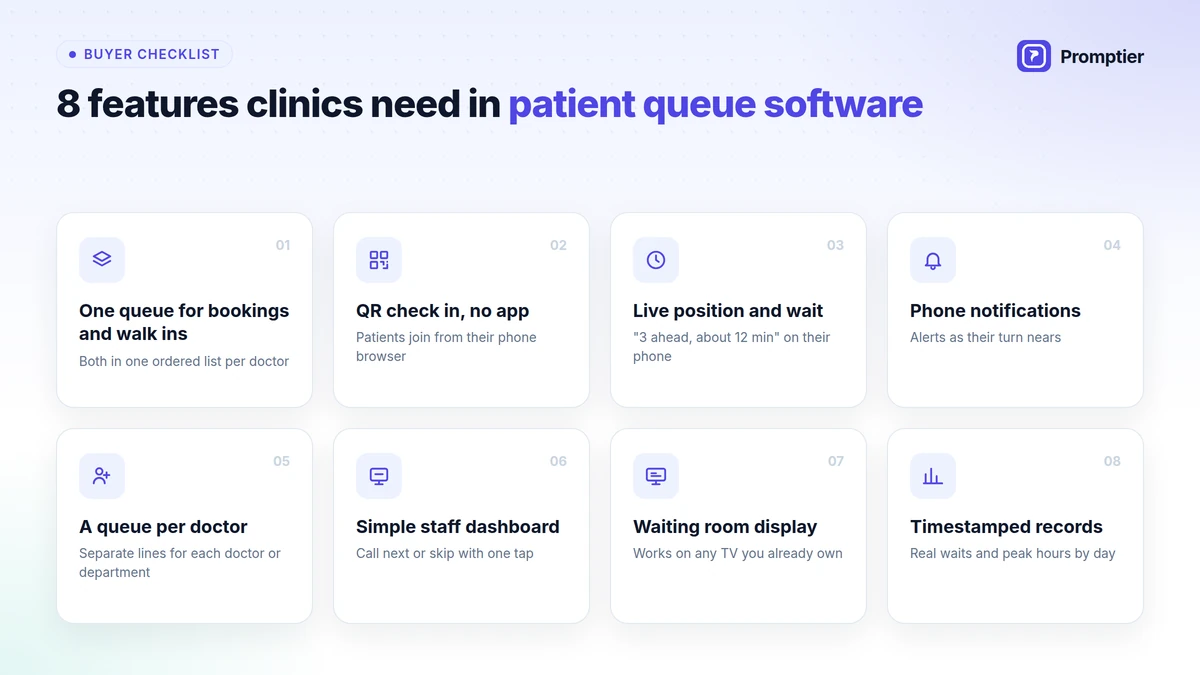
    Eight features clinics need in patient queue management software: one queue for bookings and walk ins, QR check in, live position, notifications and more

    1. Appointments and walk ins in one queue

    This matters more than anything else. Booked and walk in patients should appear in one ordered list per doctor, marked “Booked” or “Walk in”, so the front desk never has to merge two lists by hand. If a tool handles only walk ins or only bookings, you’ll still be juggling.

    2. QR check in with no app

    Patients should join by scanning a QR code at reception and follow their place in their phone’s browser. Asking a patient with a fever to download an app and create an account won’t work.

    3. Live position and estimated wait

    Each patient should see “3 ahead of you, about 12 minutes” on their phone, updated as the doctor calls patients. This one feature removes most “how much longer?” questions at the desk.

    4. Phone notifications

    Patients should be notified on their phone as their turn nears. That lets them wait outside, in their car or at the pharmacy, which keeps the waiting room less crowded.

    5. A queue for each doctor or department

    A clinic with two doctors, or a doctor plus a lab or physiotherapy, needs a separate queue for each. Patients should see the queue for the doctor they are waiting for, not one mixed line.

    6. A simple staff dashboard

    Reception and doctors should be able to call next or skip with one tap, from any phone, tablet or laptop. If staff need training to use it, they won’t.

    7. A waiting room display

    A TV or monitor in the waiting area should show the token being seen. It helps patients who look up rather than at their phones, and it should work on a screen you already own.

    8. Timestamped records

    Every check in, call and consultation should be recorded with a time. That gives you real waiting times, peak hours by day, and a record to check when a patient says they were skipped.

    How Appointments and Walk Ins Share One Queue

    Here’s how a typical morning looks for one doctor when bookings and walk ins are in the same queue:

    TimeWhat happensWhat the front desk sees
    10:00Doctor starts. Two walk ins scanned the QR code at 9:50.One list: Walk in, Walk in, Booked 10:30, Booked 10:45
    10:25Booked patient for 10:30 arrives at reception.They are already in the list, marked Booked. Walk ins can see how many are ahead of them.
    10:40The 10:45 booked patient messages that they’ll be late.The next walk in is already in the list, so the doctor keeps seeing patients.
    11:00Three more walk ins join from the waiting room QR code.They join the same list, and every patient’s estimated wait updates.
    11:30Morning ends.Every entry has join, call and finish times for the day’s report.

    Nobody merges lists by hand, and nobody argues about who came first, because everyone can see the same queue. This is the approach behind Promptier’s appointment and queue management system, which shows booked patients and walk ins together in one dashboard for each service.
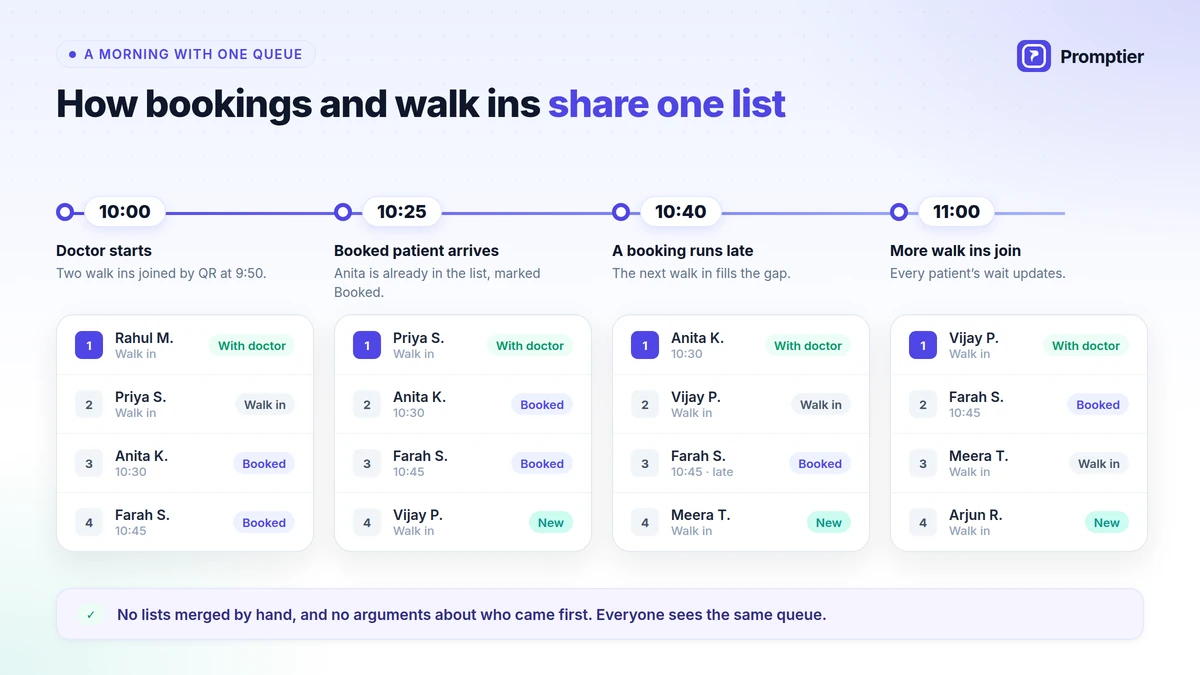
    One clinic queue through a morning, with booked and walk in patients in the same list and the next walk in seen when a booking runs late

    Patient Queue Management Options Compared

    Paper registerToken machineBooking app plus token queuePatient queue management software
    Handles bookings and walk ins togetherNoNoNo, two separate listsYes, one live queue
    Patient sees live positionNoNo, only the number calledNoYes, on their phone
    Estimated waitNoNoCounts only one listCounts everyone in the queue
    Patient can wait outsideNoRiskyRiskyYes, notified on their phone
    Data on waiting timesNoneLimitedSplit across two toolsEvery entry timestamped
    HardwareNoneDispenser, paper, servicingDispenser or registerNone, runs on existing devices
    SetupInstantVendor installationTwo tools to set upUsually the same day

    What Patient Queue Management Software Costs

    Costs vary widely, so compare the whole cost, not just the monthly fee.

    • Token machines cost roughly ₹9,000 to ₹40,000 or more for the hardware, plus paper rolls and servicing. See the full breakdown in our token machine vs digital queue cost comparison.
    • Hospital and clinic management suites often include a basic queue module, but the queue is one small part of a larger, more expensive system.
    • Browser based queue software usually charges a monthly subscription, with no hardware. Promptier, for example, is free to start, and its Pro plan is ₹499 per month per location, including 1,000 bookings a month.

    Also count the hidden costs: receptionist time spent merging lists, doctor time lost to no show gaps, and patients who leave because the wait looked too long.

    10 Questions to Ask Before You Choose

    Use these questions in any demo. A vendor that can’t answer them clearly isn’t the right fit for a clinic.

    • Can booked and walk in patients sit in one queue, clearly marked?
    • Can patients check in by QR code without installing an app or creating an account?
    • Do patients see their live position and estimated wait, and does the estimate count both bookings and walk ins?
    • Are patients notified on their phone as their turn nears?
    • Can I run a separate queue for each doctor or department?
    • Does it run on the phones, laptops and TV we already have, or do we need to buy hardware?
    • Is every entry timestamped, and can I see or export waiting time data?
    • What patient data is collected, where is it stored, and who can see it? Clinics handle personal data, and India’s Digital Personal Data Protection Act, 2023 applies, so ask for a clear answer.
    • How long does setup take, and who helps us if something goes wrong? Is support available in IST hours?
    • What does it cost in total, including bookings, extra staff logins and additional locations?

    How to Set Up Patient Queue Management in Your Clinic

    With a browser based system, most clinics can be live in a day:

    1. Create a queue for each doctor or service, such as “Dr Mehta, General” or “Physiotherapy”.
    2. Share your booking link on WhatsApp, your Google Business Profile and your website, so patients can book ahead.
    3. Print the QR code and place it at the entrance and reception for walk ins, with one line: “Scan to join the queue. No app needed.”
    4. Open the display page on the waiting room TV.
    5. Log in reception and doctors on the phones or laptops they already use.
    6. Tell patients they can wait outside. A small sign helps: “Follow your place on your phone. We’ll notify you.”
    7. Check the data after two weeks. Look at average waits, peak hours and no shows, then adjust booking slots and staffing.

    How Promptier Works for Clinics

    Promptier is a clinic queue system built around the collision that clinics deal with every day: bookings and walk ins arriving at the same desk.

    • Appointments and walk ins in one queue. Booked patients and walk ins appear together in one dashboard for each service, so reception calls the next patient from one list.
    • Built in booking. Patients book from a link you share on WhatsApp, Google or your website.
    • QR check in, no app. Walk ins scan a QR code and join from any phone browser.
    • Live position and estimated wait, with phone notifications as their turn nears, so patients can wait anywhere.
    • A queue per service or doctor, shown on any TV you already own.
    • Every entry timestamped, so you can see real waiting times and peak hours.
    • No hardware. Most clinics are live the same day.
    • Pricing. Free to start. Pro is ₹499 per month per location with 1,000 bookings a month. Multi location clinics and hospital groups can ask for Enterprise pricing.

    Running a larger OPD? See the hospital queue management system and our complete guide to queue management in hospitals.

    See how Promptier puts appointments and walk ins in one queue

    Frequently Asked Questions

    What is patient queue management software?

    Patient queue management software is a digital system that manages how patients check in, wait and get called for consultation. It keeps an ordered queue for each doctor, shows each patient their live position and estimated wait, and records every visit with timestamps.

    Does a patient queue system replace my clinic management system or EMR?

    No. Clinic management software and EMRs hold patient records, prescriptions and billing. A queue system manages the waiting room: who is here, who is next and how long each patient will wait. Most clinics use both.

    Can one system handle both appointments and walk in patients?

    Yes, and for most clinics it should. The best tools put booked patients and walk ins in one live queue for each doctor, so the front desk works from one list instead of merging a booking diary and a token register by hand.

    Do patients need to download an app?

    Not with a browser based system. Patients scan a QR code or open a booking link, and everything runs in their phone’s browser. There’s nothing to install and no account to create.

    How does it reduce waiting room crowding?

    Patients can see their live position and estimated wait on their phone and are notified as their turn nears, so they don’t need to stay in the waiting room. Many choose to wait outside or run a short errand instead.

    How much does patient queue management software cost in India?

    It depends on the type. Token machines cost roughly ₹9,000 to ₹40,000 or more in hardware, plus upkeep. Browser based software usually has a monthly fee and no hardware. Promptier is free to start, and its Pro plan is ₹499 per month per location.

    How long does it take to set up in a clinic?

    With a browser based system, most clinics are live the same day. You create a queue for each doctor, share your booking link, print a QR code and open the dashboard on devices you already have.

    Conclusion

    A clinic’s waiting room problem is rarely about the doctor’s speed. It comes from running bookings and walk ins in separate places, and from patients who can’t see how long they’ll wait.

    The right patient queue management software fixes both. It puts every patient in one queue, shows each one their live position, lets them wait outside, and gives you the data to plan your day. Choose a tool that does that without an app for patients or hardware for you, and your front desk will feel the difference in the first week.

    Ready to end the collision at your front desk? See how Promptier’s appointment and queue management system works and book a free demo. No hardware, no patient app, support in IST hours.

    Related reading
  • Queue Management System in Hospital: The Complete Guide

    Queue Management System in Hospital: The Complete Guide

    A queue management system in hospital OPDs does one job a paper token can’t: it moves each patient through registration, the right doctor’s OPD, pharmacy, lab and billing without a separate crowded line at every step.

    Ask any hospital administrator in India what happens between a patient walking in and seeing a doctor, and “queue” undersells it. There’s a registration line, a doctor-wise OPD queue, a pharmacy queue, a lab queue and a billing queue. That’s four or five separate waits stitched into one visit, and most are still run on paper tokens or a register.

    This guide covers what a hospital queue system needs to do, how it works stage by stage, what to look for when buying one, and how the check-in step now connects to ABDM and the DPDP Act.

    A queue management system in hospital OPDs is software that lets patients check in by QR code, kiosk or appointment, puts them in the right queue for their doctor or department, shows their live position and expected wait on their phone, alerts them when their turn is near, and logs every step with a timestamp. It replaces paper tokens and one blended OPD line.

    Key Takeaways

    • A hospital visit is several linked queues: registration, doctor-wise OPD, pharmacy, lab and billing. A hospital queue system has to route patients across all of them, not manage one line.
    • The biggest wait-time win is usually routing, not faster doctors. A 5-minute pharmacy pickup shouldn’t wait behind a 20-minute consultation.
    • In a study of 30 hospitals in Nellore, Andhra Pradesh, average OPD waits ranged from 15.5 minutes in private hospitals to 39.71 minutes in voluntary-sector hospitals, and men’s median wait was 19% lower than women’s.
    • Check-in is where a patient’s ABHA ID is captured or verified. ABDM’s Digital Health Incentive Scheme (DHIS) pays facilities for ABHA-linked records, but its rates change often, so check the current terms.
    • A patient’s name, phone number and visit time are personal data under the DPDP Act, 2023. The DPDP Rules, notified on 14 November 2025, phase in compliance over 18 months.

    What Is a Queue Management System in a Hospital?

    A queue management system in hospital settings is software that lets patients check in digitally (by QR code, kiosk or pre-booked appointment), routes them into the correct queue (a specific doctor’s OPD, pharmacy, lab or billing), tracks the live wait, and logs each stage of the visit for records and reporting.

    A retail or bank queue manages one kind of wait. A hospital visit is a chain of them. A patient might register, wait for a specific doctor, walk to the pharmacy, wait again, then queue at billing. A single “take a token” system can’t represent that. A hospital queue system needs doctor-wise and department-wise routing from the start, so a patient’s place in the pharmacy queue depends on when they reach the pharmacy, not when they arrived at the hospital.

    The other thing specific to healthcare is the record. Every check-in captures at least a name and phone number, and increasingly a link to the patient’s ABHA health ID. That record needs to be accurate, timestamped and collected with proper notice.

    Key terms used in this guide:

    • Doctor-wise and department-wise routing: automatically placing a patient in the correct sub-queue (a specific doctor’s OPD, pharmacy, lab or billing) instead of one blended line.
    • ABHA ID: the Ayushman Bharat Health Account, a 14-digit health ID under the Ayushman Bharat Digital Mission (ABDM) that links a patient’s records across providers.
    • DHIS: the Digital Health Incentive Scheme under ABDM, which pays health facilities for KYC-verified, ABHA-linked digital health records above a monthly baseline.
    • Personal data (DPDP Act, 2023): any data about an individual who can be identified by it. A patient’s name, phone number and visit timestamp all qualify.

    Where Hospital Queue Management Fits in the Patient Journey

    Queue management spans four stages of a hospital visit, not just the wait at one counter. A system that only covers one stage solves a smaller problem than it appears to.

    • Pre-arrival: online appointment booking, visit instructions and, where the hospital participates in ABDM, advance ABHA linkage. A patient who arrives already registered has a much faster check-in.
    • Arrival: check-in by QR code, kiosk or front desk. This is where consent for data use is captured and where the patient gets a realistic wait estimate instead of silence.
    • Service: doctor-wise OPD, pharmacy, lab and billing. Routing, live wait visibility and staff call-up matter most here.
    • Post-visit: billing, prescription pickup and follow-up booking. This is also where the visit’s data (wait times, no-shows, service durations) becomes something the hospital can analyse instead of losing to a paper register.

    Why This Matters for Hospitals in India Right Now

    Three things are converging on hospital front desks in 2026: evidence that OPD waits are long and unevenly spread, ABDM incentives tied to how patients are registered, and legal duties under the DPDP Act for the data collected at check-in.

    The evidence on waiting times. A study of 830 patients at 30 randomly selected hospitals in Nellore, Andhra Pradesh, found average OPD waits of 20.3 minutes in government hospitals, 15.5 minutes in private hospitals and 39.71 minutes in voluntary-sector hospitals (Sriram and Noochpoung, IJCMPH, 2018). After adjusting for other factors, men’s median wait was 19% lower than women’s. Patients arriving by ambulance waited 64% less than others, except in public hospitals. The data is from one district in 2012, but the pattern is the point: none of it shows up on a paper token system. It only becomes visible once check-in and wait times are logged.

    ABDM and DHIS. Hospitals are being encouraged to create ABHA-linked patient records. Under DHIS, facilities earn incentives for KYC-verified, ABHA-linked records above a baseline of 100 a month. Under Corrigendum 7 (April to September 2026), that’s about ₹5 per OP consultation or prescription record and ₹10 per discharge summary or diagnostic report (ClaimsLens summary). The scheme has been revised seven times since January 2023, so check the official DHIS page before building projections. Because check-in is where a patient’s ABHA ID is captured or verified, the queue and ABHA linkage should be designed together.

    The DPDP Act. A patient’s name and phone number collected to run a queue are personal data, and the hospital is a data fiduciary with notice and consent duties. The DPDP Rules were notified on 14 November 2025, with an 18-month phased compliance period (PIB). This is general information, not legal advice. Have your compliance or legal team review how patient data is captured and used.

    Key Benefits of a Hospital Queue Management System

    A queue management system in hospital OPDs shortens the time patients spend standing in corridors, gives staff a timestamped record of every visit, and turns check-in into a clean moment for consent and ABHA linkage.

    • Shorter, more predictable waits. Routing a 5-minute pharmacy pickup away from a 20-minute consultation queue means the pharmacy patient doesn’t inherit someone else’s wait. It’s a structural fix, not a “hire more staff” fix.
    • A record of patient flow. Every check-in, transfer and completion is timestamped, so “how long did this patient wait for Dr. X?” has a real answer.
    • One check-in for queue, consent and ABHA. Digital check-in can show patients what data is collected and why, log their consent, and prompt for their ABHA ID where your systems support it.
    • Visibility into access gaps. If some patient groups wait longer, logged data is the only way to see it and fix it.
    • Calmer waiting areas. Patients who can wait in the cafeteria or parking area instead of a packed OPD corridor are more comfortable and easier to manage.
    • Department-level reporting and less front-desk pressure. Administrators see OPD, pharmacy, lab and billing waits separately instead of one blended average, and staff field fewer “how much longer?” questions.
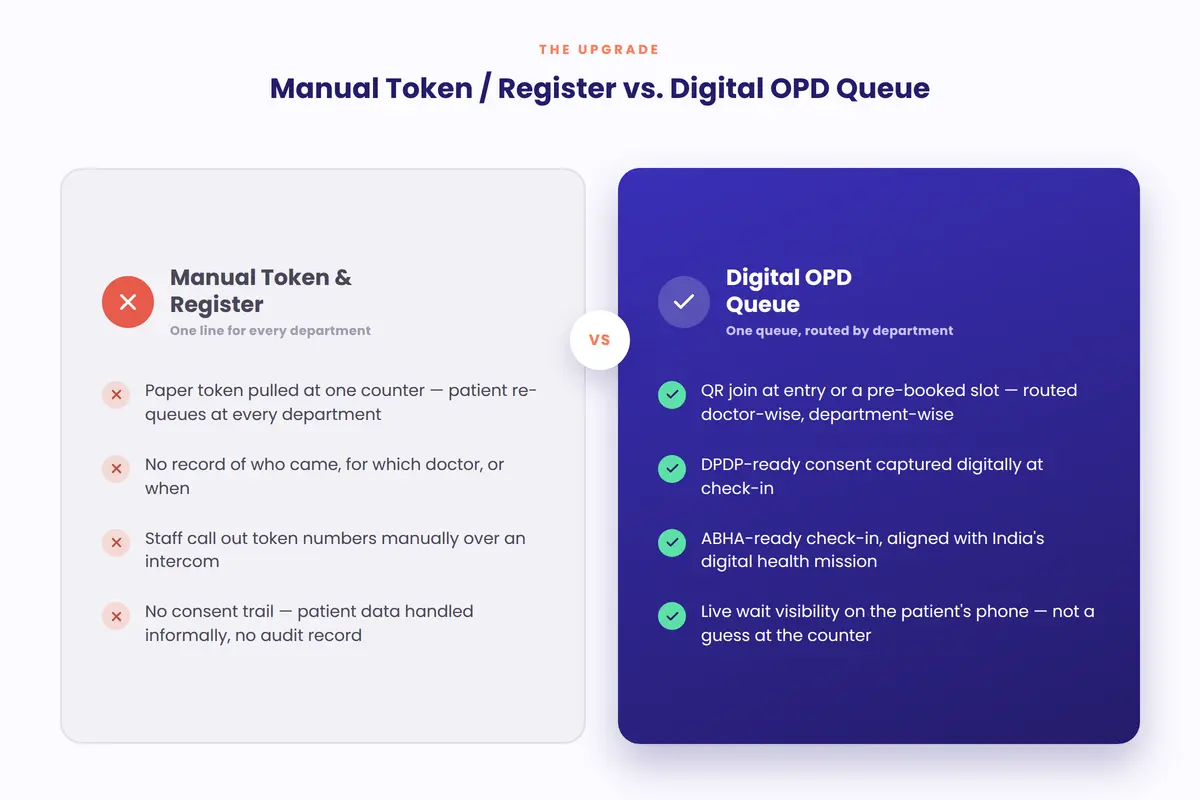
    Comparison of manual hospital token counters versus digital OPD queue management
    DimensionManual Token / RegisterDigital Hospital Queue
    Department routingOne line per counter, manually managedOPD/pharmacy/lab/billing routed automatically
    Wait-time visibilityAnecdotal, department by departmentLogged and comparable across departments
    ABHA linkageA separate administrative step, if done at allCaptured at the same check-in moment
    Consent for patient dataNot collectedCaptured at check-in, logged
    Equity visibilityInvisibleMeasurable (e.g., wait time by patient group)
    ROI evidenceAnecdotal or unsourced vendor claimsGrounded in independently published research

    How a Hospital Queue Management System Works

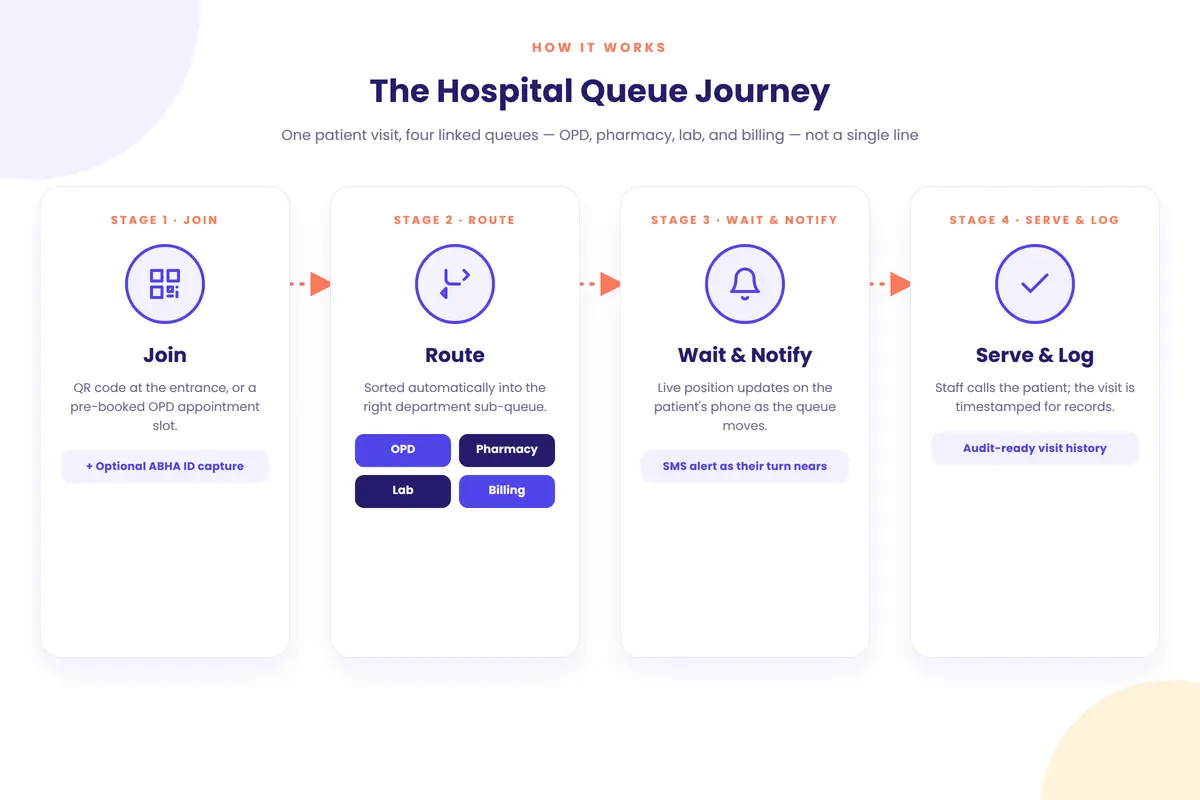
    A hospital queue system runs a four-stage flow: the patient checks in, the system routes them to the right queue, they wait with a live position and a phone alert, and each stage is logged when it’s completed.

    Workflow diagram of a hospital queue from patient check-in through department routing to service completion

    Stage 1: Join

    A walk-in patient scans a QR code, checks in at a kiosk or is registered at the front desk. A patient with a booked appointment checks in the same way. They see a clear consent notice and, where the hospital participates in ABDM, are prompted to link or verify their ABHA ID. The output is a token with a queue position, an estimated wait and a logged consent record.

    Stage 2: Route

    The patient picks, or staff assign, the reason for the visit: a specific doctor’s OPD, pharmacy, lab or billing. The system places them in that sub-queue instead of one blended line. In Promptier, for example, each doctor or department is set up as its own queue (see how hospital queue management works).

    Stage 3: Wait and Notify

    The patient’s position and estimated wait update live on their phone. As their turn nears, they get a phone notification (a browser alert, SMS or WhatsApp message, depending on the system), so they don’t need to stand by the door.

    Stage 4: Serve and Log

    Staff or the doctor call the next token, the patient is served, and the system logs the timeline: check-in time, department, wait duration and completion time. That record feeds the hospital’s dashboard and, where relevant, ABDM reporting.

    StageCadenceOwnerTypical Tooling
    JoinContinuousPatient (self-service) or front deskQR code, kiosk, booking link, consent notice
    RouteAutomatedSystemDoctor/department sub-queues
    Wait & NotifyContinuousSystemLive position, SMS alert
    Serve & LogPer visitStaff/doctorCounter or room call-up, timestamped record

    Best Practices for Hospital Queue Management

    The single most useful practice is routing by doctor and department before optimising anything else. Most long OPD waits come from blended queues, not slow individual service.

    • Route by doctor, not just by department. One OPD line for every doctor in a specialty hides who is running late. A sub-queue per doctor gives each patient a realistic wait for the doctor they’re actually seeing.
    • Separate quick transactions from long ones. Pharmacy, lab and billing each get their own queue, so a 5-minute pickup doesn’t wait behind a 20-minute consultation.
    • Capture ABHA at check-in, not as an afterthought. Offer ABHA linkage in the same flow as joining the queue, rather than at a separate desk patients skip.
    • Make consent part of check-in. Show a clear notice and log the patient’s consent, instead of collecting a phone number with no record.
    • Track wait time by patient group. One overall average hides gaps. Check whether women, elderly patients or walk-ins wait longer, and find out why.
    SituationWhat to doExpected result
    One OPD line for several doctorsGive each doctor a sub-queuePatients see a realistic, doctor-specific wait
    Pharmacy and billing stuck behind consultationsGive each department its own queueTotal visit time drops without adding staff
    ABHA linkage at a separate deskOffer it at queue check-inHigher linkage rate, less patient friction
    No view of wait time by patient groupTrack and review it weeklyAccess gaps become visible and fixable

    Common Challenges and How to Solve Them

    The most common mistake is digitising the main registration desk and stopping there. Registration gets faster, but pharmacy, lab and billing stay on paper, so the patient’s total visit barely gets shorter and the project gets blamed.

    Only registration gets digitised

    Plan department coverage from day one, even if the rollout is phased. Commit to a date for pharmacy, lab and billing rather than leaving them “for later”.

    Elderly or less digitally comfortable patients struggle with QR check-in

    Keep a staffed front desk or kiosk that can issue a token on the patient’s behalf. Digital-first doesn’t have to mean digital-only.

    ABHA linkage feels like extra work at a busy desk

    Build it into the same check-in flow as joining the queue, so it’s one prompt, not a separate errand.

    Consent text copied from a generic template

    A generic “I agree” box may not meet the DPDP Act’s standard of free, specific, informed and unambiguous consent. Have your compliance or legal team review the actual notice patients see.

    Doctors resist visible wait-time data

    Frame the data around patient flow and staffing, not individual doctor speed, and involve clinical leadership in how it’s used before rolling it out hospital-wide.

    No plan for downtime

    If the internet or system goes down on a busy OPD morning, you need a fallback. Keep a paper token or register process ready, and ask any vendor what happens during an outage.

    Real-World Scenarios

    These are illustrative scenarios based on common patterns in Indian hospital OPDs, not case studies of named institutions.

    Government hospital OPD, high daily volume. A government OPD on paper tokens had no way to see that its waits were concentrated in two specialties during morning hours. With doctor-wise digital queues, administrators could see the real bottleneck and adjust which doctors covered the peak, instead of assuming the whole OPD needed more staff.

    Private multi-specialty hospital, ABDM rollout. ABHA linkage was low because front-desk staff treated it as a separate, optional step during busy mornings. Folding ABHA capture into queue check-in raised linkage without adding a counter or a new step for patients.

    Diagnostic and lab department. The lab shared a waiting area and a queue with OPD consultations, so a 10-minute blood draw regularly waited behind a 25-minute follow-up. Giving the lab its own queue cut lab waits without changing consultation schedules at all.

    Real-World Scenarios

    These are illustrative scenarios based on common patterns across hospital OPD operations in India, not case studies of named institutions.

    Government hospital OPD, high daily volume. A government hospital OPD running purely on paper tokens had no way to see that its average wait, closer to the 20-minute range typical of public facilities, was concentrated in two specialties during morning hours. After introducing doctor-wise digital queuing, administrators could see the actual bottleneck by specialty and adjust which doctors saw patients during the peak window, rather than assuming the whole OPD needed more staff.

    Private multi-specialty hospital, ABDM rollout. A private hospital participating in ABDM found ABHA linkage rates were low because front-desk staff treated it as a separate, optional step during a busy morning. Folding ABHA capture into the same QR check-in flow as queue joining lifted linkage rates without adding a new counter or a new step for patients.

    Diagnostic and lab department. A hospital’s lab department shared a waiting area with OPD consultation patients, so a 10-minute blood draw regularly waited behind a 25-minute consultation follow-up. Giving the lab its own queue, separate from OPD consultations, shortened lab wait times without touching consultation scheduling at all.

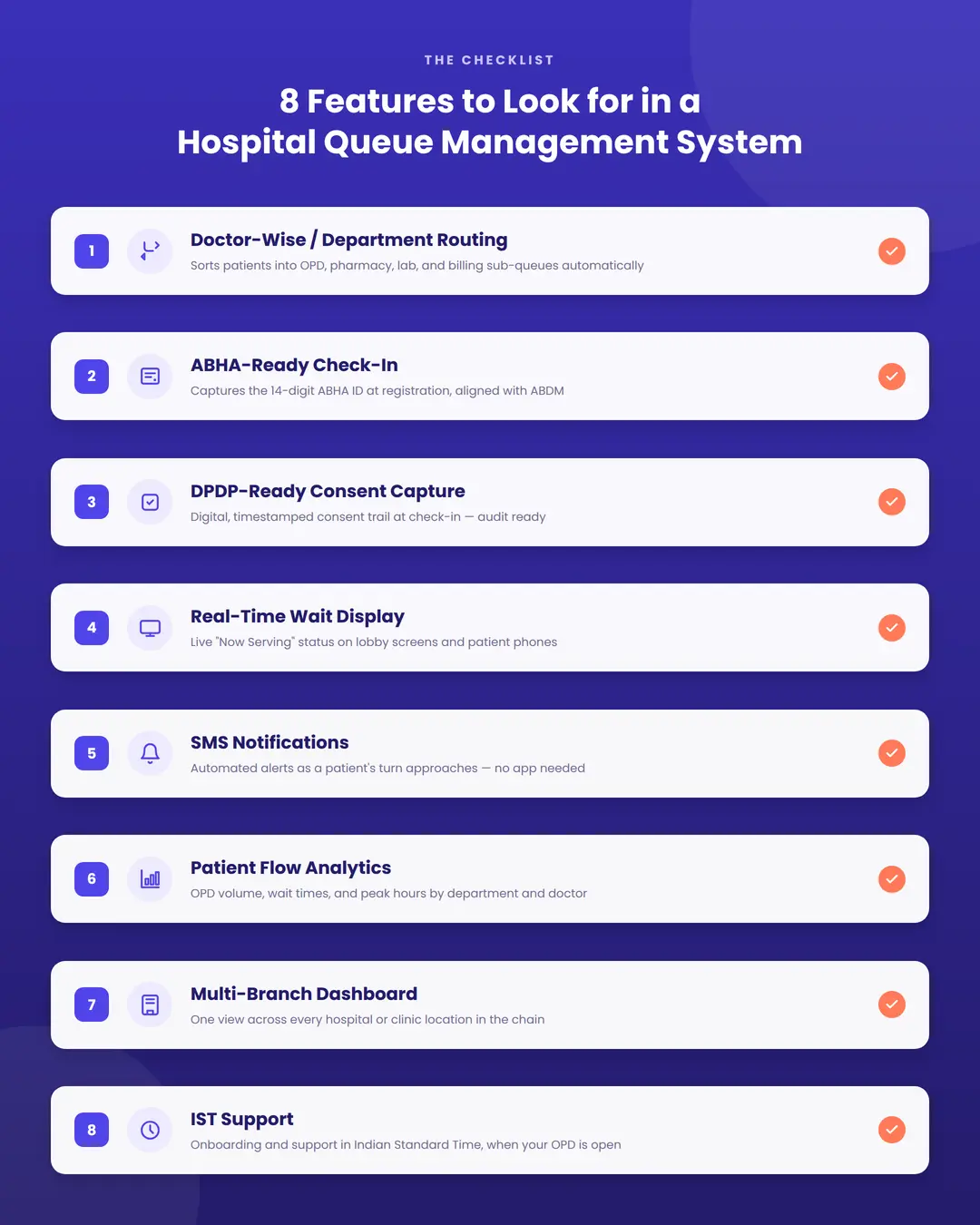
    8 Features to Look for in a Hospital Queue Management System

    When you evaluate a queue management system in hospital OPDs, doctor-wise routing and proper consent capture matter most, because a generic retail queue tool is least likely to handle them well for a hospital.

    Infographic checklist of 8 features to look for in a hospital queue management system
    FeatureWhat it doesWhy it mattersLook for
    Doctor and department routingSorts patients into the right sub-queueQuick visits don’t wait behind long onesSeparate queues per doctor or department
    Walk-ins and appointments togetherMerges booked and walk-in patientsOne true order for each doctorBoth visible in one dashboard
    ABHA-ready check-inCaptures or verifies ABHA ID at check-inSupports ABDM and DHISInline prompt or HIS integration
    Consent captureShows and logs a data noticeDPDP Act complianceA visible, logged consent step
    Live wait displayShows the token being served per departmentLowers how long a wait feelsWorks on existing TVs
    Phone notificationsAlerts patients as their turn nearsFrees patients from crowded corridorsBrowser, SMS or WhatsApp alerts; timing per department
    Patient flow analyticsReports waits, volume and no-showsTurns complaints into dataDepartment and doctor-level detail, exportable
    IST support and multi-branch viewSame-timezone help; one view across sitesFast fixes during OPD peaks; comparison across branchesA stated support window and role-based access

    How Promptier Works for Hospitals and Clinics

    Promptier is a QR-based queue management system in hospital OPDs and clinics that runs on the phones, laptops and screens you already have. There’s no hardware to buy, and most clinics go live the same day.

    • QR check-in with no app. Patients scan a QR code and join the queue in their phone browser.
    • Walk-ins and appointments in one dashboard. Booked and walk-in patients sit in one view, so each doctor’s queue is in the right order.
    • Separate queues by doctor or department. Set up OPD, pharmacy, lab and billing as their own queues.
    • Live position and estimated wait. Patients see where they stand and are notified on their phone as their turn approaches.
    • Lobby TV display. Open a URL on any smart TV or monitor to show the token being served.
    • Timestamped records. Every entry is logged, and wait-time data can be exported for audits and reviews.
    • Pricing. Free to start. Pro is ₹499 per month per location. Enterprise pricing for hospital groups is custom.

    If you need ABHA capture or integration with your hospital information system (HIS), ask about it in your demo, as these aren’t listed on the product page yet.

    See how Promptier’s hospital queue management system works

    Future Trends

    • ABDM integration becoming expected. As ABDM adoption grows, hospitals that already fold ABHA linkage into check-in will be ahead of those treating it as a separate project.
    • Clearer DPDP guidance for patient data. As the 18-month DPDP Rules rollout continues, expect clearer standards on consent and notice for healthcare data.
    • Wait prediction from visit history. With enough logged visits, systems can forecast OPD waits by doctor and time of day, which helps both patient messaging and staffing.

    Frequently Asked Questions

    What is a queue management system in a hospital?

    A queue management system in hospital OPDs is software that lets patients check in by QR code, kiosk or appointment and places them in the right queue: a specific doctor’s OPD, pharmacy, lab or billing. It shows their live position and wait, alerts them when their turn is near, and logs each stage of the visit instead of relying on paper tokens.

    How long do patients wait in Indian hospital OPDs?

    It varies widely. One study of 30 hospitals in Nellore, Andhra Pradesh, found average OPD waits of 20.3 minutes in government hospitals, 15.5 minutes in private hospitals and 39.71 minutes in voluntary-sector hospitals, with women waiting longer than men. Waits in large city hospitals can be much longer, which is why hospitals need their own logged data.

    How much does a hospital queue management system cost in India?

    Costs range from free starter plans to custom enterprise contracts. Promptier is free to start, its Pro plan costs ₹499 per month per location, and hospital groups get custom Enterprise pricing. Hardware-based token systems cost more upfront because they need dispensers, displays and servicing.

    Is patient data collected by a hospital queue system covered by the DPDP Act?

    Yes. A patient’s name, phone number and visit timestamp are personal data under the DPDP Act, 2023. The hospital collecting them is a data fiduciary with notice and consent duties. The DPDP Rules were notified on 14 November 2025 with an 18-month phased rollout. This is general information, not legal advice.

    Can a queue system help with ABDM and ABHA linkage?

    Yes, if it’s designed to. A queue system can prompt for or verify a patient’s ABHA ID at the same moment they check in. ABHA-linked records can count towards ABDM’s Digital Health Incentive Scheme, but the scheme is run by the National Health Authority and its rates change often, so check the current terms.

    Does a queue management system replace the registration desk?

    No. Most hospitals keep a staffed registration desk or kiosk alongside QR check-in, both for patients who can’t or don’t want to use a phone and as a fallback if the system or internet is down.

    How is a hospital queue system different from a bank or retail queue system?

    A hospital visit chains several queues together: registration, doctor-wise OPD, pharmacy, lab and billing. A hospital queue system needs routing by doctor and department, handling of walk-ins alongside appointments, and more careful handling of patient data than a typical retail queue.

    What is the biggest mistake hospitals make with queue management software?

    Digitising only the front desk. Registration gets faster, but pharmacy, lab and billing stay on paper, so the bottleneck simply moves and the patient’s total visit time barely changes.

    Conclusion

    A queue management system in hospital OPDs has to do more than replace a paper token. It has to route patients across a chain of departments, make a measurable dent in waits that research shows are long and uneven, and treat check-in as what it now is: the moment for consent and, where ABDM applies, ABHA linkage.

    A faster front desk feels like progress. But if pharmacy, lab and billing stay on paper, the patient’s visit barely gets shorter. The hospitals getting real results treat this as a whole-journey project, not a registration-desk upgrade.

    When you compare options, look closely at doctor-wise routing, how consent and ABHA are handled at check-in, and whether the reporting shows you wait-time gaps you didn’t know about.

    See it work in your OPD. Explore Promptier’s hospital queue management system and book a free demo. No app for patients, no new hardware, support in IST hours.

    Related reading