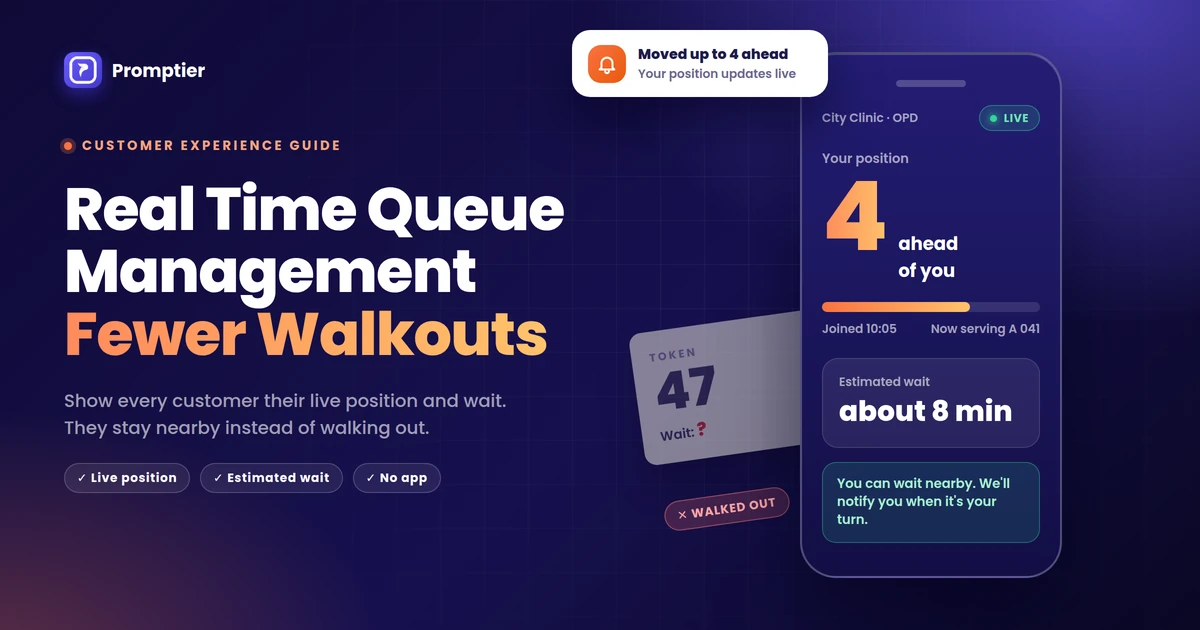
Real time queue management shows every waiting customer where they stand in the line and how long they have left, updated live on their own phone. That one change matters more than it sounds. Most customers don’t walk out because the wait is long. They walk out because they can’t tell how long it is.
You have seen it happen. A customer walks into your clinic, salon or service centre, sees a full waiting area, takes a paper token, waits ten minutes with no idea how far the counter has got, and quietly leaves. You never find out why, and you never see them again.
This guide explains what real time queue management is, why uncertainty drives walkouts, and how showing live position keeps customers in the queue.
Real time queue management is a way of running a queue where each customer’s position and estimated wait update live as the line moves, usually on their phone after scanning a QR code. It reduces walkouts because it removes uncertainty. Customers who can see their place and wait time are less anxious, can wait nearby instead of in the lobby, and don’t fear losing their turn.
Key Takeaways
- Uncertainty makes waits feel longer than they are. Research on the psychology of waiting has made this point since the 1980s.
- There are two kinds of walkout: customers who see the crowd and never join, and customers who join and give up halfway.
- A live position and estimated wait replace a guess with a number, which lowers anxiety and makes people more willing to stay.
- Because the queue lives on the customer’s phone, they can wait in their car or step out on an errand without losing their place.
- Every queue entry is timestamped, so you can count walkouts instead of guessing at them.
What Is Real Time Queue Management?
Real time queue management is a queue system that tracks every customer from the moment they join to the moment they are served, and shows the current state of the line to customers and staff as it changes. When staff call the next customer, everyone else’s position moves up immediately, on their phone and on the lobby screen.
A traditional queue stops at issuing a number. A real time queue keeps talking to the customer until their turn comes.
Key terms used in this guide:
- Live position: the customer’s current place in the line, such as “4 ahead of you”, which updates each time someone is called.
- Estimated wait: an approximate time until the customer is served, based on how fast the line is moving.
- Virtual queue: a queue that customers join from their phone, so they don’t need to stand in a physical line.
- Walkout: a customer who leaves without being served. Operations researchers split this into balking (seeing the queue and never joining) and reneging (joining and then leaving).
Why Customers Walk Out: It’s the Uncertainty, Not Only the Wait
Long waits cause walkouts, but they aren’t the whole story. The same 20 minute wait can feel fine or unbearable depending on what the customer knows.
Service researcher David Maister described this in his well known essay The Psychology of Waiting Lines. Three of his eight principles explain most walkouts:
- “Uncertain waits are longer than known, finite waits.” A customer told “about 15 minutes” settles in. A customer told nothing starts checking the clock.
- “Unexplained waits are longer than explained waits.” If the line stops moving and nobody knows why, patience drops fast.
- “Anxiety makes waits seem longer.” The biggest worry in a paper token queue is simple: “If I step out for a minute, will I miss my turn?”
What a customer can’t see in a paper token queue
Hand someone a slip that says 47 and they have to answer these questions on their own:
- How many people are ahead of me?
- How fast is the line moving?
- How long will I be here?
- Can I step out, or will I lose my turn?
- Was someone served out of order?
With a crowd and a token display that shows only the last number called, the customer guesses. Most people guess high. Some of them leave.
The walkout loop
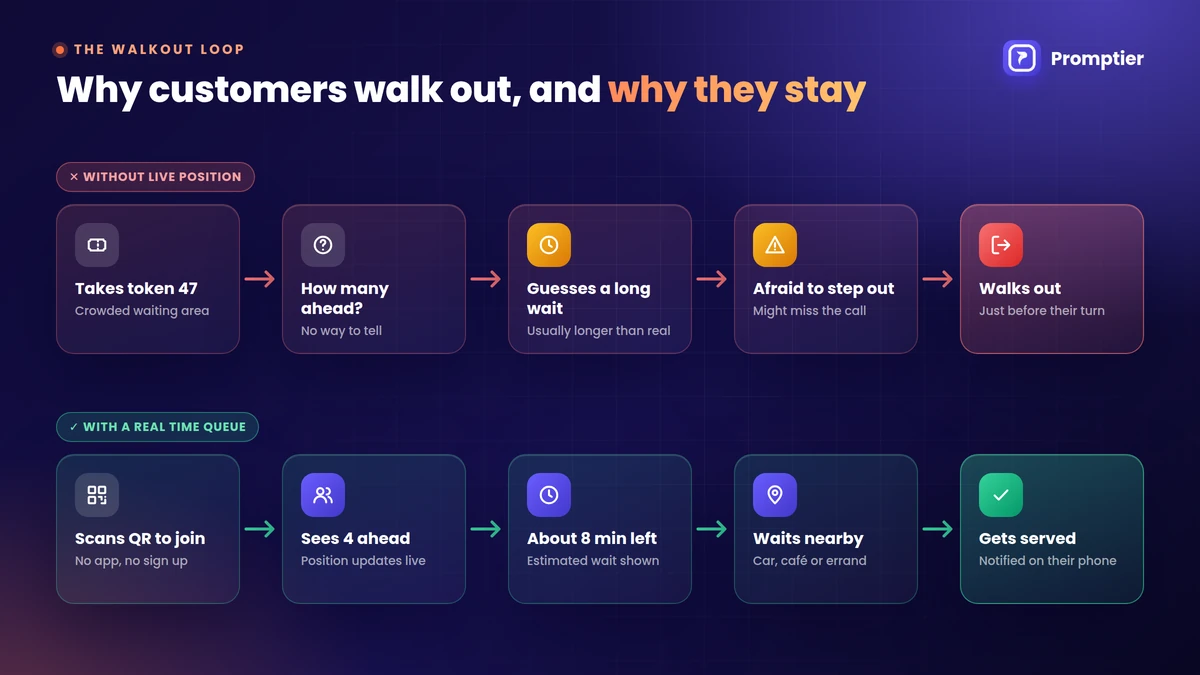
A walkout usually follows the same five steps:
- The customer arrives and sees a full waiting area.
- They can’t see their position or how fast the line moves.
- They guess the wait is long, usually longer than it really is.
- Anxiety builds, because they can’t leave without risking their turn.
- They leave, often just before they would have been called.
The cost doesn’t stop with one lost sale. That customer may not come back, may tell others about the wait, and may leave a review about it. And the slot they gave up often goes unused while staff call a number that nobody answers.
How Live Position Keeps Customers in the Queue
If uncertainty drives walkouts, the fix is to take the uncertainty away. A live queue does that in five ways.
Research backs this up. A study in Management Science by Qiuping Yu, Gad Allon and Achal Bassamboo looked at how customers react to announced wait times and found that delay announcements change both what customers expect and how costly the wait feels to them. A separate study of ticket queues by Kaan Kuzu, Long Gao and Susan Xu found that customers adapt their patience to the waiting context and keep updating their decision as they learn more. Put simply, people decide whether to stay based on the information you give them. Give them better information and more of them stay.
1. A known number replaces a guess
“6 ahead of you, about 12 minutes” is something a customer can plan around. They can reply to a message, call home or just relax. A guess of “who knows, maybe an hour” makes them leave.
2. Customers can wait anywhere
This is the biggest change. With a real time queue on their phone, the customer doesn’t need to stay in the lobby to keep their place. They can sit in their car, get a coffee or finish a quick errand nearby, and watch their position move. Most walkouts happen because staying feels like a trap. Take the trap away and the reason to leave goes with it.
3. Progress is visible
Watching your position drop from 7 to 6 to 5 feels like movement, even when the line is slow. Maister called this out as well: people want to feel the process has started. A number on a slip that never changes gives the opposite feeling.
4. The order is visibly fair
Maister’s research found that unfair waits feel longer than fair ones. In a crowded lobby, one person being served out of turn can make five others leave. In a real time queue, everyone sees their position move in order, and staff calls are recorded, so arguments about who came first mostly disappear.
5. A notification removes the fear of missing a turn
The last worry is “what if they call me while I’m away?” When the customer’s phone tells them it’s their turn, that worry goes away. They can relax instead of watching the counter.
Paper Token vs Real Time Queue: What the Customer Sees
| Question the customer has | Paper token or crowd | Real time queue |
|---|---|---|
| How many are ahead of me? | Unknown. They count heads or guess. | Shown live, such as “4 ahead of you” |
| How long will it take? | Unknown | Estimated wait shown and updated |
| Can I step out? | Risky. They might miss their number. | Yes. Their place is kept on their phone. |
| Is the line moving? | Only if they watch the display | Position drops each time someone is called |
| Will I know when it’s my turn? | Only if they’re in the room | Notified on their phone |
| Was it fair? | Hard to tell in a crowd | Order is visible and every entry is timestamped |
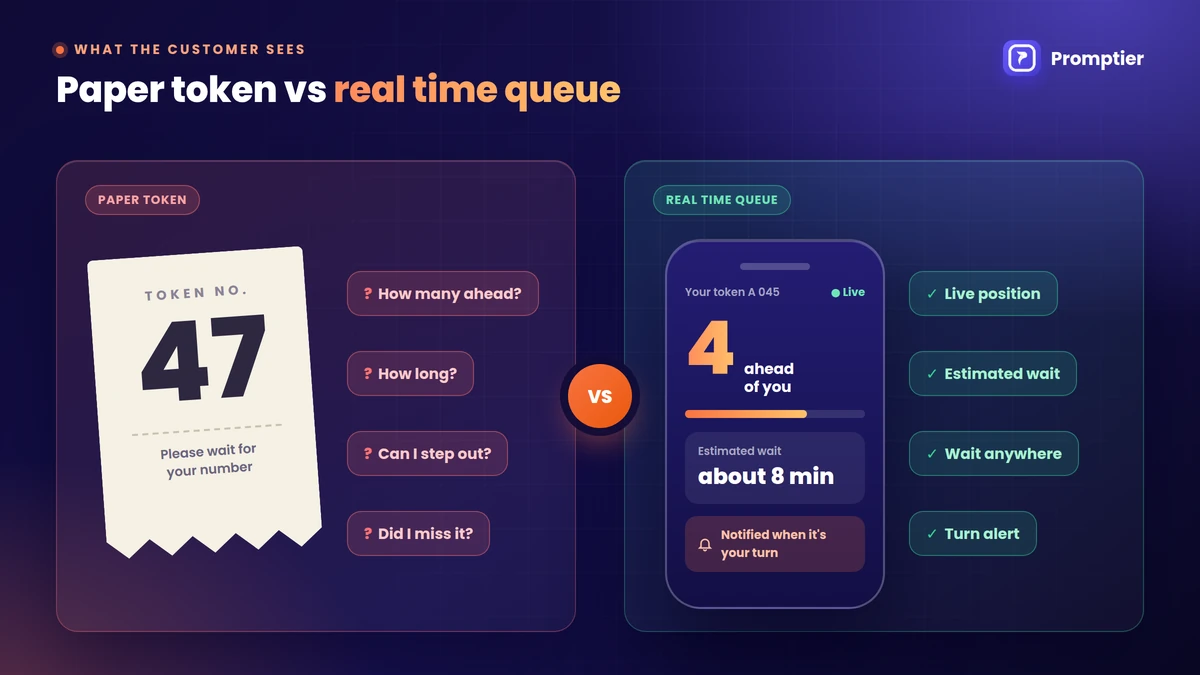
The table shows why the effect on walkouts can be large even when the actual wait doesn’t change. The service takes the same time. What changes is how the wait feels, and whether the customer has to stay in the room for it.
What Staff See on a Real Time Queue Dashboard
A live queue isn’t only for customers. The same live data gives staff and owners a clear view of the line:
- Who is waiting right now, in order, with the time each person joined
- Call next and skip buttons, so the queue moves with one tap
- A lobby display on any TV or monitor, showing the number being served
- A timestamped record of every entry, from joining to being served
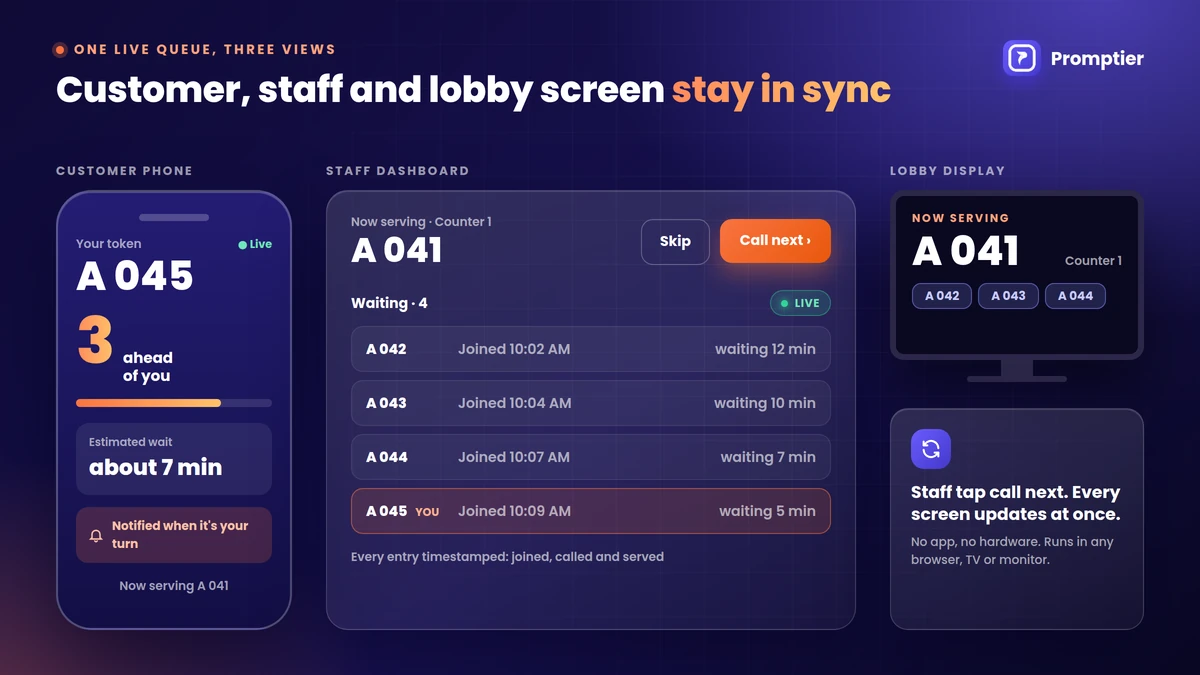
A real time queue management system like Promptier runs all of this in the browser. Customers join by scanning a QR code with no app, staff manage the line from a live dashboard, and the lobby screen works on any smart TV or monitor you already own.
How to Set Up Real Time Queue Management
Setting up a real time queue doesn’t need new hardware. A typical setup looks like this:
- Create your queue. Name it after your business or the service, such as “OPD” or “Haircut”.
- Print the QR code. Put it at the entrance and at the reception desk, with one line of text: “Scan to join the queue. No app needed.”
- Open the lobby display. Load the display page on a TV or monitor in the waiting area. This step is optional but helps customers who look up rather than down.
- Log staff in. Each staff member opens the dashboard on a phone, tablet or laptop and uses call next when they’re free.
- Tell customers they can step out. This is the step most businesses forget. A small sign that says “Watch your place on your phone. You can wait outside.” turns the feature into fewer walkouts.
- Review the data weekly. Look at waits, peak hours and customers who left, and adjust staffing.
How to Measure Walkouts Before and After
You can’t reduce what you don’t measure, and most businesses have never counted their walkouts. Here’s a simple way to do it.
Before you switch (one or two weeks):
- Count paper tokens issued each day.
- Count customers actually served.
- The gap between the two is roughly your walkout count.
After you switch (same number of weeks):
- Count queue entries each day from your dashboard.
- Count entries served.
- Count entries that were skipped or never served.
Compare the walkout rate, which is walkouts divided by customers who joined, for the two periods. Compare the same weekdays so a busy Monday isn’t matched against a quiet Wednesday.
To see what walkouts cost, try an example. A clinic sees 60 walk in patients a day. If 5 leave before being seen and the average bill is ₹400, that’s ₹2,000 a day, or about ₹50,000 over 25 working days. Winning back even half of those is worth far more than the cost of a real time queue.
Where a Live Queue Helps Most
Walkouts hurt most where customers arrive without a booking and the wait varies:
- Clinics and hospital OPDs, where patients wait unsure of their turn and often step out for pharmacy or food
- Salons and barbershops, where a full waiting area makes new customers walk past
- Bank branches and service centres, where different jobs take very different times
- Government and utility offices, where queues are long and people fear losing their place
- Restaurants with a waitlist, where diners want to wait nearby rather than at the door
How Promptier Does Real Time Queue Management
Promptier is a browser based queue system built for Indian businesses.
- QR check in, no app, no sign up. Customers scan and join from any phone browser.
- Live position and estimated wait. Customers see their place in line and how long is left.
- Notified on their phone when it’s their turn, so they can wait anywhere.
- Live staff dashboard with call next and skip.
- Lobby display on any screen you already own, from a smart TV to a spare monitor.
- Every entry timestamped, so you can measure waits and walkouts.
- No hardware. Most businesses go live the same day.
- Pricing. The Starter plan is free for up to 30 customers a day. Pro is ₹499 per month with up to 3 staff members and 1,000 bookings a month. Enterprise pricing covers multiple branches.
If you’re still using paper tokens or a token machine, see the real cost comparison of token machines and digital queues.
Start your free trial of Promptier
Frequently Asked Questions
What is real time queue management?
Real time queue management is a way of running a queue where each customer’s position and estimated wait update live as the line moves. Customers usually join by scanning a QR code and follow their place on their phone, while staff manage the line from a live dashboard.
Why do customers walk out of queues?
Most customers walk out because of uncertainty, not only because of the length of the wait. When they can’t see how many people are ahead or how long it will take, they guess high, feel anxious about losing their turn if they step away, and leave.
How does real time queue management reduce walkouts?
It replaces a guess with a live position and an estimated wait, shows the line moving in a fair order, and lets customers wait anywhere because their place is kept on their phone. They are notified when it’s their turn, so they don’t fear missing it.
What is the difference between balking and reneging?
Balking is when a customer sees the queue and leaves without joining. Reneging is when a customer joins the queue and leaves before being served. A live queue helps most with reneging, because customers can wait away from the lobby once they have joined. It can also reduce balking, since a QR code at the door lets people join in seconds instead of judging the wait by the size of the crowd.
Do customers need an app for a real time queue?
No. With a browser based system like Promptier, customers scan a QR code and join in their phone’s browser. There’s no app to download and no account to create.
How do I measure walkouts in my business?
Compare how many customers joined the queue with how many were served. The difference, divided by the number who joined, is your walkout rate. A real time queue system records every entry with timestamps, so you can track this every day.
Is there a free real time queue system?
Yes. Promptier’s Starter plan is free for up to 30 customers a day with one staff account. Busier businesses can move to the Pro plan at ₹499 per month.
Conclusion
Most customers who walk out of your queue aren’t reacting to a long wait. They’re reacting to an unknown one. They can’t see their place, they can’t tell if the line is moving, and they can’t step away without losing their turn.
A live queue fixes each of those problems. A live position replaces the guess, visible progress makes the wait feel shorter, and a notification on their phone lets them wait anywhere. The service takes the same time, but more of your customers stay to receive it.
Try it with your own customers. Start a free trial or see how Promptier’s real time queue management works. No hardware, no customer app, support in IST hours.
Related reading