The instinctive answer to a long line is “we need another person on the counter.” It’s not always wrong, but it’s the most expensive fix available, and in a lot of businesses, it’s not even the right one — the line isn’t long because there aren’t enough hands, it’s long because of how customers join, how they’re routed, and how the existing staff’s time gets spent. A receptionist or counter staff hire in India costs roughly ₹1.7–2 lakh a year even at entry level, before training time and the productivity dip while they ramp up. Before that number gets signed off, it’s worth spending fifteen minutes on the cheaper fixes first.
This guide walks through seven ways to cut walk-in wait times using the staff you already have, what they cost to implement, and a straightforward way to tell whether your business has actually run out of room to optimize — because sometimes it has, and hiring genuinely is the right call.
Key Takeaways
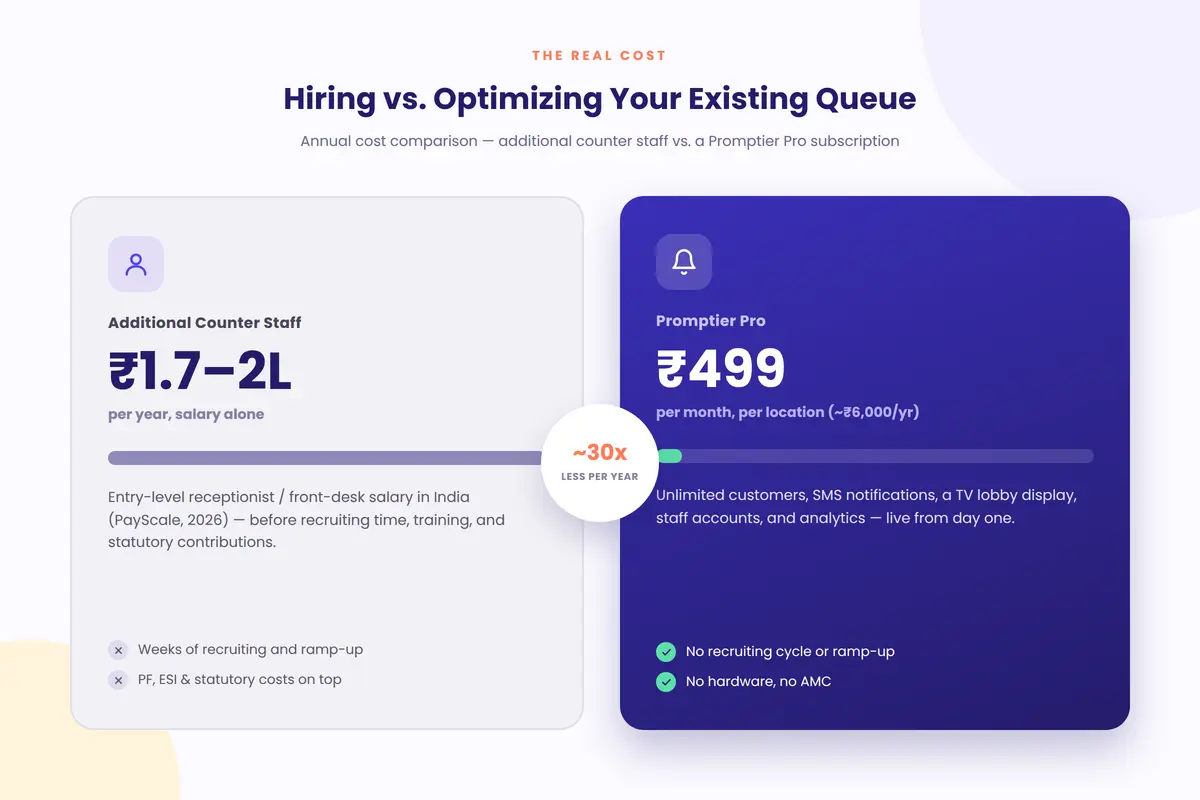
- An entry-level receptionist or counter staff hire in India costs roughly ₹1.7–2 lakh a year in salary alone, before training and ramp-up time — often more than a year of queue management software.
- Most wait-time problems are join-and-routing problems, not staffing problems: customers standing in one line for services that take wildly different amounts of time is a bigger driver of perceived wait than headcount.
- A real staff-scheduling case study using queue data reported wait times dropping from 15 to 7 minutes and staff utilization rising from 68% to 89% — from the same team, using better scheduling, not more people.
- Letting customers join a queue remotely and see a live wait estimate reduces the in-person crowding that makes queues feel unmanageable, even when total service time doesn’t change.
- Hiring is still the right call when queue data shows you’re consistently over 85–90% staff utilization during open hours — at that point, no amount of routing or scheduling has room left to work with.
Why Wait Times Grow Even When You’re Not Understaffed
Wait times often grow because of how a queue is structured, not because there aren’t enough staff — a five-minute request stuck behind a twenty-minute one, customers who all show up in the same 30-minute window, or a front desk that’s doing data entry instead of serving the next person all inflate wait time without changing headcount.
Before assuming the fix is another hire, it’s worth checking for three specific patterns that inflate wait time independent of staffing levels:
- One line, many service types. A single queue that mixes a 2-minute question with a 20-minute consultation means everyone behind the long request waits longer than the line’s actual average would suggest.
- Demand bunching. If most customers arrive in the same short window — lunch hour, right after opening, a specific day of the week — the queue looks understaffed for 45 minutes and overstaffed the rest of the day, even though total daily service capacity is fine.
- Staff time going to queue admin, not service. Manually calling names, checking a register, or physically managing a line takes real time away from actually serving customers — time a digital queue reclaims without adding a person.
None of these are solved by an additional hire. They’re solved by restructuring how the queue works, which is usually far cheaper and faster to fix.
The Real Cost of “Just Hire More Staff”
An entry-level receptionist or counter staff role in India costs roughly ₹1.7–2 lakh a year in salary alone, according to 2026 compensation data — before recruiting time, training, and the weeks of reduced productivity while a new hire ramps up. A queue management subscription typically costs a fraction of that per year, with no ramp-up period.
Compensation research for receptionist and front-desk roles in India shows entry-level salaries averaging around ₹1.71 lakh a year, rising to roughly ₹1.91 lakh with a few years of experience, with a broader market range extending well beyond that for larger cities and more specialized roles. That’s the direct salary cost alone — it doesn’t include the time a manager spends recruiting and interviewing, the training period before a new hire is fully productive, or the ongoing cost of PF, ESI, and other statutory contributions that typically add to the base figure.
Compare that to a queue management subscription: Promptier’s Pro plan runs ₹499 a month per location — about ₹6,000 a year — with no recruiting cycle and no ramp-up period, since the software is either configured correctly on day one or it isn’t. That doesn’t mean software always replaces the need for a hire; it means the hire should be the second option you reach for, not the first, because the cost gap is large enough to be worth fifteen minutes of checking first.
7 Ways to Cut Wait Times Without Adding Headcount
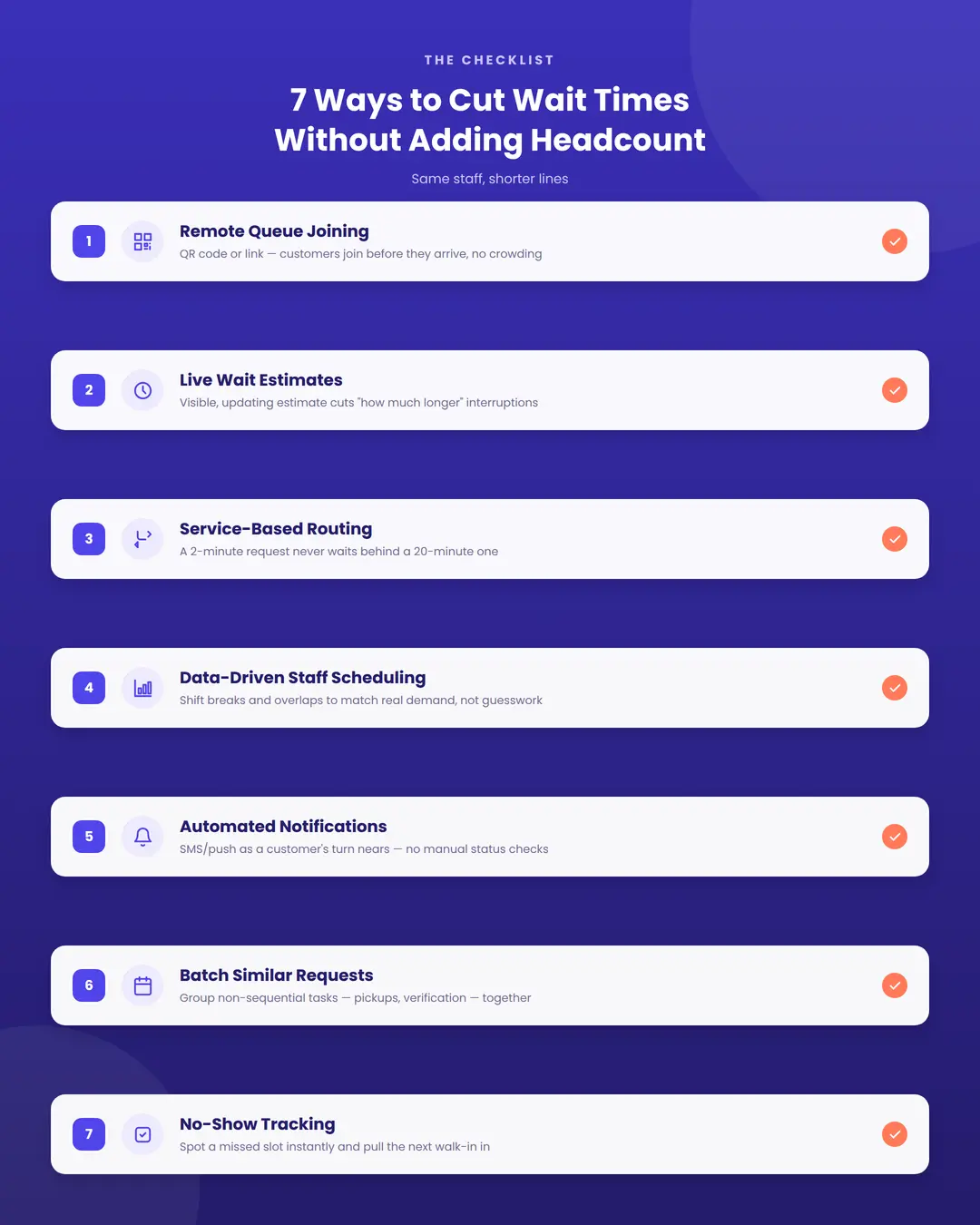
Short Answer: The seven highest-leverage changes are: letting customers join remotely, showing them a live wait estimate, routing by service type instead of one line for everything, scheduling existing staff against actual demand data, automating the “where do I stand” interruptions, batching similar requests together, and tracking no-shows so slots don’t sit wasted.
1. Let Customers Join the Queue Remotely
If a customer can join the queue from their phone before they arrive — via a QR code, a link, or a pre-booked slot — they’re not physically occupying space in the shop while they wait, which reduces the crowding that makes a queue feel unmanageable to both customers and staff, even when the total number of people served per hour hasn’t changed.
2. Give Customers a Live Wait Estimate
A visible, continuously updating wait estimate does two things at once: it reduces how often customers interrupt staff to ask “how much longer,” and it measurably increases how long people are willing to wait before giving up, because uncertainty — not the wait itself — is usually what drives frustration and walkouts.
3. Route by Service Type, Not One Line for Everything
Splitting a single queue into service-specific sub-queues — quick questions in one line, longer consultations in another — means a 2-minute request never gets stuck behind a 20-minute one. This alone can cut average perceived wait significantly without changing how many people are served per hour.
4. Schedule Existing Staff Against Actual Demand Data
Most walk-in businesses staff by fixed shift patterns rather than actual demand. Queue join-time data reveals exactly when demand spikes and dips, which lets a manager shift existing staff’s break times, lunch rotations, and shift overlaps to match real patterns — covered in more detail below.
5. Automate the “Where Do I Stand” Interruptions
Every time a customer walks up to ask staff how much longer they’ll wait, that’s service time being spent on queue administration instead of the next customer. Automated SMS or push notifications as a customer’s turn approaches eliminate most of these interruptions entirely.
6. Batch Similar Requests Together
For services that don’t require strict first-come-first-served ordering — document verification, form collection, simple pickups — grouping similar requests and handling them in a short batch is often faster in total than serving them one at a time interleaved with unrelated requests.
7. Track No-Shows So Slots Don’t Sit Wasted
A no-show on a booked appointment is wasted staff capacity if nobody notices until the slot has already passed. Tracking no-shows in real time lets staff pull the next walk-in into that slot immediately instead of it sitting empty.
Use Queue Data to Schedule Your Existing Staff Better
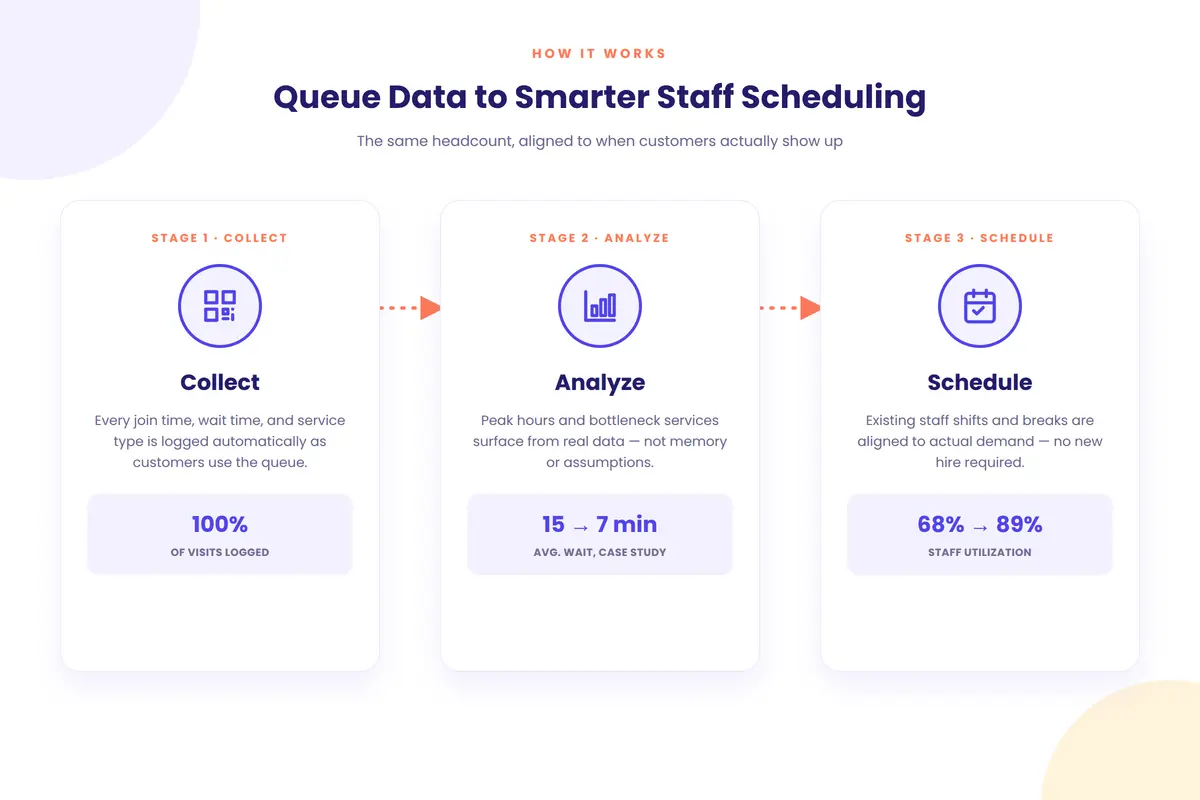
The single biggest lever here is scheduling staff to match actual, measured demand instead of a fixed shift template — one documented case study using this approach saw average wait time drop from 15 to 7 minutes and staff utilization rise from 68% to 89%, using the same headcount.
Most walk-in businesses schedule staff the same way every week: fixed shifts, fixed breaks, regardless of whether Tuesday afternoon is genuinely slower than Monday morning. Once a queue system is logging every join time, wait time, and service duration, that guesswork goes away. A documented case study of this approach — reported in coverage of queue-data-driven scheduling at Apollo Hospitals — found that shifting from reactive, fixed scheduling to demand-based scheduling reduced average wait times from about 15 minutes to 7 minutes and raised staff utilization from 68% to 89%, alongside a reported reduction in staff overtime and a jump in customer satisfaction from 68% to 87%.
The mechanism is straightforward: instead of reacting to a line that’s already formed, a manager staffs proactively for the specific windows the data shows are busiest, and pulls staff toward breaks or other tasks during the windows that are consistently quiet. None of this requires a new hire — it requires knowing, rather than guessing, when the existing team’s time is actually needed.
A 30-Day Plan to Test This Before You Hire
Short Answer: Spend the first two weeks collecting real queue data with your current staff unchanged, then use weeks three and four to test service-type routing and demand-based scheduling — only consider hiring if wait times and staff utilization haven’t meaningfully improved by day 30.
- Week 1–2: Measure, don’t change anything yet. Put a digital queue in place (even the free tier of a tool like Promptier) purely to capture join times, wait times, and service types. Don’t adjust staffing or routing — the goal is an honest baseline.
- Week 3: Split the queue by service type. If your data shows a mix of quick and long requests in one line, split them into separate queues and watch what happens to average wait.
- Week 3–4: Align shifts to the demand pattern. Use the two weeks of data to see where staff time is over- or under-allocated relative to actual customer arrivals, and adjust break timing and shift overlap accordingly.
- Day 30: Check the numbers. Compare wait times and staff utilization to your baseline. If they’ve improved meaningfully, keep iterating before considering a hire. If staff utilization is still consistently above 85–90% during open hours despite these changes, that’s a real signal — move to the next section.
When You Genuinely Do Need to Hire
Short Answer: Hiring is the right call when queue data shows staff utilization consistently above roughly 85–90% during business hours even after routing and scheduling are optimized — at that point, there’s no slack left in the existing team’s time, and no software fix changes that.
None of this is an argument against ever hiring — it’s an argument against hiring as the default first response to a long line. The signal that you’ve genuinely run out of room is when your queue data shows staff are already working close to full capacity during open hours, wait times stay high even during well-scheduled periods, and no-shows or slow periods aren’t producing meaningful slack to redistribute. At that point, the constraint is real hours of human capacity, not a fixable inefficiency, and the honest move is to hire — ideally with queue data in hand to make the case and to right-size exactly how much additional capacity you need, rather than guessing.
Frequently Asked Questions
Can I really reduce wait times without spending anything?
Some of it, yes — splitting a queue by service type or adjusting shift timing based on observation costs nothing. But measuring demand accurately enough to make good decisions usually requires some form of digital queue tracking, which is why starting with a free tier of a queue tool is a low-risk first step.
How much does an additional counter staff hire cost in India?
Entry-level receptionist and front-desk roles average roughly ₹1.71 lakh a year in salary, rising to about ₹1.91 lakh with a few years of experience, according to 2026 compensation research — not counting recruiting time, training, or statutory contributions on top of base salary.
Does splitting a queue by service type actually help if total service time doesn’t change?
Yes, because perceived and actual average wait both improve when a short request isn’t stuck behind a long one. Total staff time spent serving customers is the same, but no individual customer is penalized by someone else’s longer request ahead of them.
What’s the fastest change to make first?
Letting customers join the queue remotely and see a live wait estimate is usually the fastest to implement and produces an immediate reduction in front-desk interruptions, since staff stop being asked “how much longer” throughout the day.
How do I know if I’ve actually run out of room to optimize?
Track staff utilization from your queue data. If it’s consistently above 85–90% during open hours even after routing and scheduling changes, there’s no slack left to redistribute, and hiring is the appropriate next step.
Conclusion
“Hire more staff” is the most expensive answer to a long queue, and in most walk-in businesses, it’s reached for before the cheaper fixes get a real try. Splitting queues by service type, giving customers visibility into their wait, and scheduling the team you already have against actual demand data routinely produce the same result as a new hire — shorter waits, less overtime, more throughput — without the recruiting cycle, the ramp-up period, or the roughly ₹1.7–2 lakh annual cost.
That’s not an argument against ever hiring. It’s an argument for measuring first. Thirty days of real queue data will tell you, honestly, whether your business has a staffing problem or a queue-structure problem — and that’s a much cheaper question to answer than finding out after the hire is made.
If you want to start measuring, try Promptier’s Starter plan for free and see what your actual queue data looks like before deciding what to do about it.
Leave a Reply